This page is available in English.
Choose your preferred language to view the siteNotice CFDs are leveraged; you do not own the underlying. Client registration and trading use backoffice.activexbt.com and platform.activexbt.com; contracting entity ACTIVE CORP LTD (Saint Lucia). KYC/AML before funding.
Product: ActiveXBT offers contracts for difference (CFDs) and related leveraged products. You do not own the underlying asset. CFDs are complex instruments and carry a high risk of losing money rapidly due to leverage.
Third-party technology: Account registration, client portal, trading terminal, deposits, and withdrawals are provided through ActiveXBT client systems (for example backoffice.activexbt.com and platform.activexbt.com). Register and Login on this marketing site link to those environments, which are separate from this website. The contracting entity for your relationship is ACTIVE CORP LTD (Saint Lucia), subject to eligibility and onboarding checks. Where the terminal interface differs from the ActiveXBT marketing brand, that reflects the client application layout, not a different retail counterparty, unless you are informed otherwise in your legal agreements.
Before you fund an account: You must complete identity verification (KYC), sanctions screening, and other anti-money-laundering steps as required by law and by our policies. Deposit routes, payment processors, and available instruments are shown only after successful onboarding in the secure client area.
This marketing website does not accept deposits or display live payment domains; those appear only inside the partner client application after KYC.
Long vs. Short
The examples below illustrate how long and short CFD positions affect your account P&L when benchmark prices move. They are simplified and educational—you trade contracts for difference, not physical gold, oil, or other deliverables.
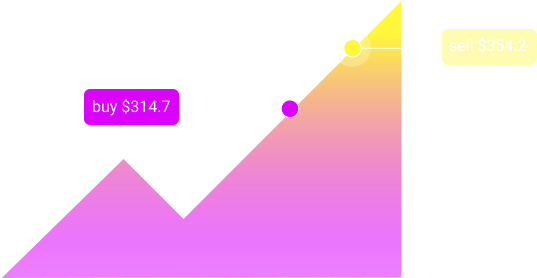
Whether you open a long CFD or a short CFD, ActiveXBT provides tools to express a view on rising or falling prices. If you are long a CFD, your account typically benefits when the reference price rises; if the reference price falls, your account may lose value. You may also open a short CFD to seek a gain if the reference price falls—commonly called "going short" versus "going long."
Example: Going Long (CFD)
Suppose gold is quoted at $2,000 per ounce and you believe the price will rise. You open a long CFD equivalent to 5 ounces at $2,000, so your notional exposure is $10,000 (you do not take delivery of metal).
ActiveXBT offers leveraged trading, allowing you to trade without having the full position value. Instead, you only need to cover the margin, which is 1% of the total position size, amounting to $100.
If your prediction is correct, and the price of Gold goes up, you may decide to close your position. Let's say the Gold price rises to $2,100, and you decide to close your position.
To calculate your profit, you need to multiply the difference between the closing price and the opening price of your position by its size.
Profit = (2,100 - 2,000) * 5 = $500 because you had a "long" position.
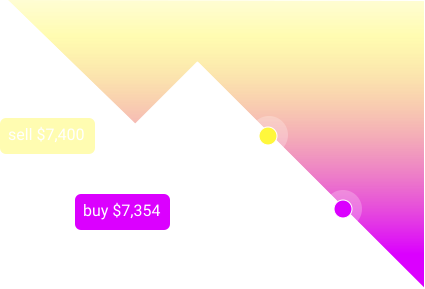
Example: Going Short (CFD)
Suppose oil is quoted near $74 per barrel and you expect the price to fall. You open a short CFD equivalent to 100 barrels at $74, giving notional exposure of $7,400 (again, no physical barrels change hands).
Oil has a margin requirement of 1% (1:100 leverage), which means you need to deposit $74 as margin collateral.
Oil's price drops to $73.50. You close the short CFD at $73.50 to crystallise the outcome shown in the calculation below.
Since this is a short position, you calculate your profit by subtracting the closing price ($73.50) from the opening price ($74) and then multiply it by the position's size, which is 100.
Profit = (74 - 73.50) * 100 = $50 because you had a "short" position.
Profit from market growth
Profit from market decline
Calculating Profits
To determine the profit or loss generated from a long/short trade, you multiply the position's size by the point difference between the opening and closing prices. Both long and short trades result in profits or losses when the position is closed.
If you have confidence in the market's direction, you can utilize leverage to gain exposure to a larger position than with a standard trade, whether you're going long or short.
Ready to open an account?
Start online registration when you are ready. Identity checks and funding are separate steps before you can trade CFDs in the terminal.